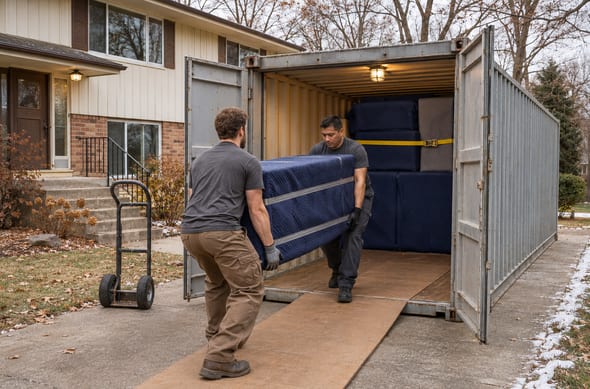


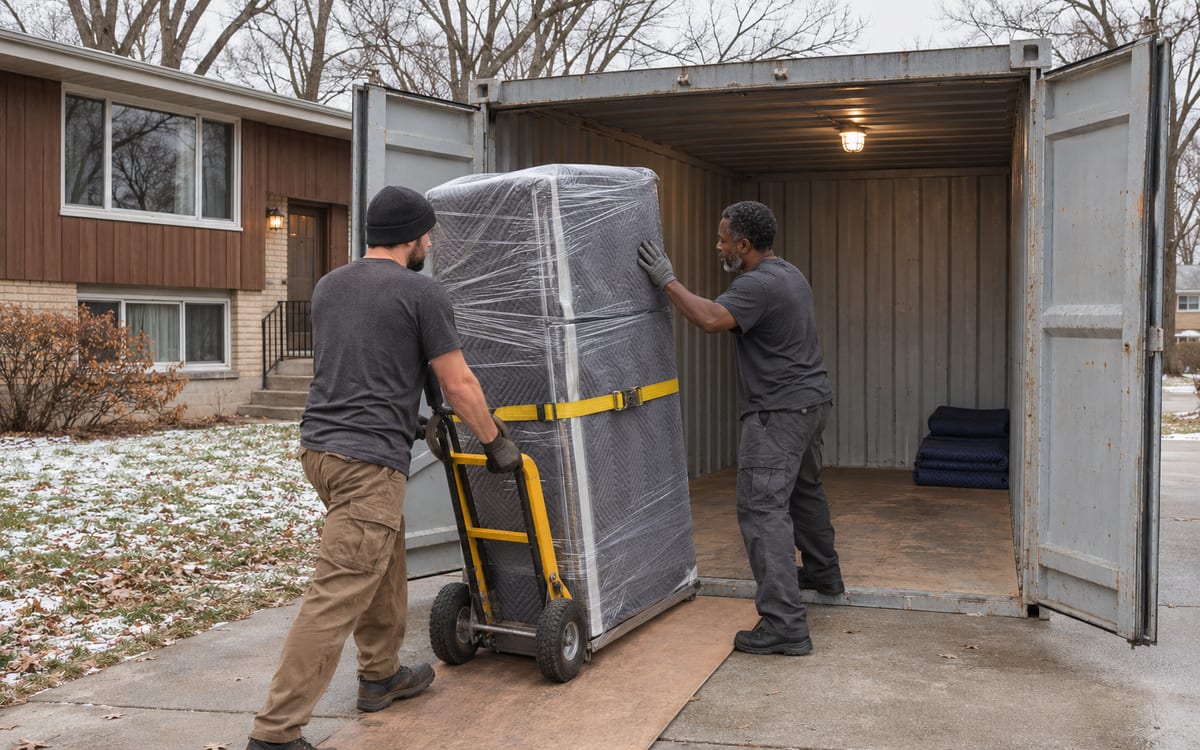
Load a moving pod with the heaviest items first, against the back wall, and spread the weight evenly side to side. Build in tiers from floor to ceiling, fill every gap so nothing can slide, and strap off each tier as you go. Fragile boxes go on top, and the last things in are the ones you need first.
The reason for all that care is what happens after you close the doors. The container gets lifted onto a truck, sometimes tipped at an angle, then driven across town or across the country. Anything loose will move. A well-loaded container arrives the way it left. If you'd rather not do the lifting yourself, you can hire movers to load your pod. Otherwise, here's how a crew does it.
How do you load a moving pod?
Six rules cover almost every container, whatever the brand:
- Heavy and big first, at the back. Appliances, dressers and sofas go against the back wall, on the floor.
- Even side to side. Don't put every heavy piece along one wall. Balance the load left and right.
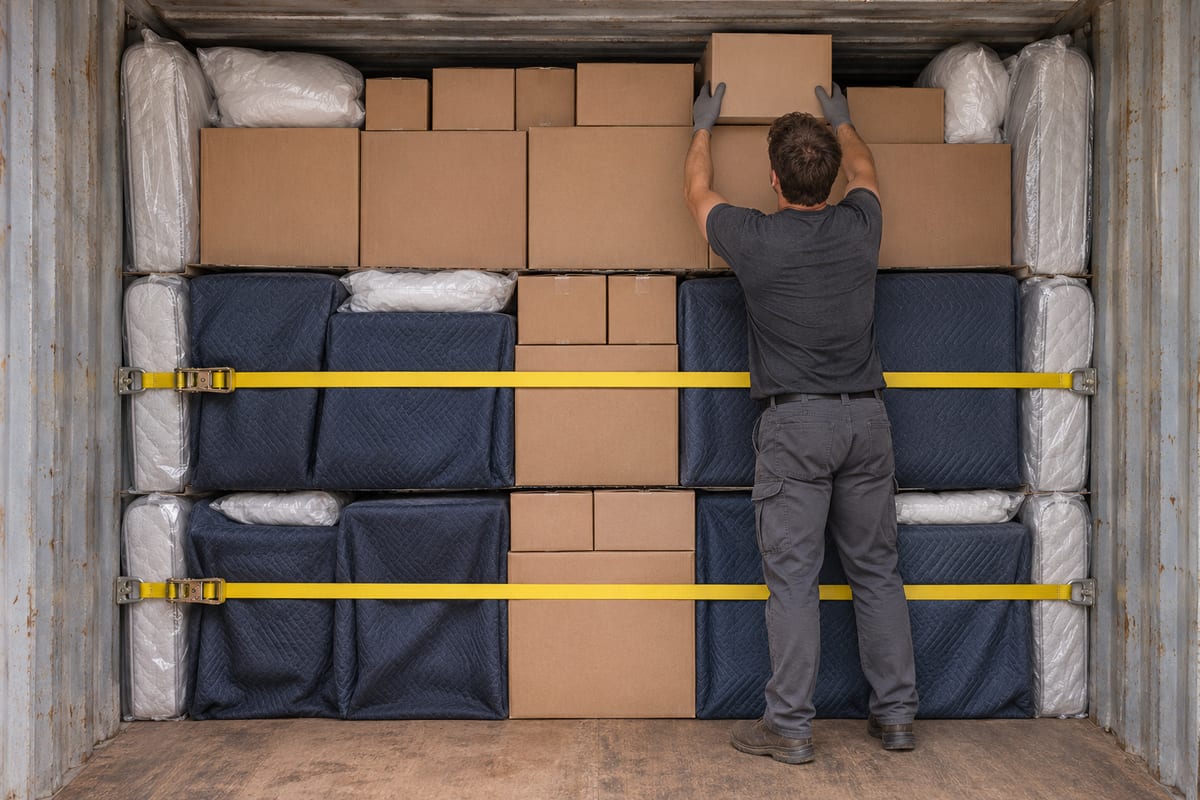
- Tiers, not stacks. Build one wall of furniture and boxes from floor to ceiling, across the full width, before you start the next.
- No gaps. Fill every space with soft things so nothing has room to slide.
- Strap every tier. Tie each tier off to the container's tie-down points before you build the next one.
- Last in, first out. The final tier holds what you'll need the first night in your new home.
The rest of this guide walks through each of those, plus what to do before the container shows up and what can't go in it at all.
Before the container arrives: pack, label, take apart
Loading goes fast when everything is ready to carry. Most of the work happens the week before.
- Pack everything that fits in a box. Loose items are what shift and break. Use a few standard box sizes so they stack into tidy walls. Heavy things like books go in small boxes, light things like linens in big ones. For dishes, art and glass, see our guide to packing fragile items.
- Seal and label every box. Write the room and a few words about the contents on two sides, not the top, because the tops are hidden once the boxes are stacked.
- Take apart what comes apart. Bed frames, table legs, desk hutches, shelving. Take glass shelves and mirrors out of furniture and pack them separately. Put the screws and bolts in a labeled bag and tape it to the piece they came off.
- Get appliances ready. Empty, clean and dry the fridge and freezer a day ahead so they don't grow mildew in a closed container. Disconnect and drain washer hoses.
- Stage by tier. Group the heavy furniture together near the door, then the boxes by weight. When the loading starts, you're carrying things in order instead of searching for them.
- Know your weight limit. PODS lists a maximum load for each container: 5,200 lbs for the 8-foot, 4,700 lbs for the 12-foot and 4,200 lbs for the 16-foot. It also says your heaviest items shouldn't add up to more than 75% of that. Go Mini's publishes estimated capacities by size. For any container, ask the company when you book if you're moving a gun safe, a piano or a garage full of tools.
For a full list of large pieces and how to handle them, see our large furniture moving tips.
Step by step: loading in tiers
Think of the container as a series of walls, built one at a time from the back to the doors. Each wall, or tier, runs the full width of the container and goes as close to the ceiling as you can get it.
- Start with the heaviest, largest pieces against the back wall. The fridge, washer and dryer, dressers and the sofa go in first, on the floor. A sofa can stand on its end to save floor space, wrapped and padded. Keep the weight balanced: if the fridge goes on the left, the washer goes on the right.
- Put tall, flat things along the side walls. Mattresses, box springs, headboards and tabletops stand on their long edges against the walls, wrapped, where they brace the rest of the tier.
- Build up with boxes. Heavy boxes on the bottom, medium in the middle, light and fragile on top. Stack them squarely, like bricks, and fill to the ceiling before you move forward. Drawers can stay full of light things like clothes if they're wrapped shut.
- Fill every gap. Pillows, couch cushions, bagged bedding, rolled rugs and bags of clothes go into the spaces between furniture and boxes. If you can push a piece and it moves, the gap isn't filled.
- Strap off the tier. Run a strap across the face of the finished tier and tighten it to the tie-down points on each side. PODS says most of its containers have eyelets about every four feet, and newer ones have e-track. Go Mini's says its containers have rails at two heights along the walls. Ask your container company where the tie-down points are in the one you're getting, and bring your own straps. PODS says those are the customer's job.
- Repeat, tier by tier, toward the doors. Each new tier follows the same pattern: heavy low, light high, gaps filled, strapped off.
- Make the last tier the one you need first. Bed frames and mattresses for the first night, a box of toilet paper, towels, the coffee maker. Our list of open-first box essentials covers the rest. Strap this tier too, so nothing falls toward you when the doors open.
Why the straps matter: not every container stays level on its way to the truck. Big Blue Boxes, for example, delivers with a rollback truck that sets one end of the container on the ground and tilts its bed to lift the container back on at pickup. PODS says its PODZILLA lift is designed to reduce shifting. Either way, the container then rides on a truck over Minnesota roads, and Go Mini's puts it plainly: items may shift during loading or transport if they aren't secured.
What not to put in a moving pod
Every container company bans hazardous materials, and the lists overlap a lot. Leave these out of any container:
- Gasoline, oil, propane tanks and anything else flammable
- Paint, varnish, paint thinner, pesticides and harsh cleaning chemicals
- Aerosol cans
- Perishable food, live plants and pets
Each company adds its own rules. PODS lists items with non-removable lithium batteries, lawn mowers, motorcycles, and alcohol and tobacco. Big Blue Boxes recommends against storing flat-screen TVs in its containers, and against candles, tapes or photos if your container will sit in storage over the summer. Go Mini's bans motor vehicles, engines, fuels and oils. Read the full list for the company you book: Big Blue Boxes, PODS or Go Mini's.
Some things are allowed but shouldn't go in anyway. Keep your important documents, medication, jewelry, cash, laptops and anything irreplaceable with you in the car. In a Minnesota winter, add anything that can freeze, like liquids, houseplants and some electronics. Our guide to moving with a pod in a Minnesota winter has the cold-weather list.
Supplies: straps, pads, plastic wrap
- Straps. Ratchet straps or cam-buckle straps, enough for one or two per tier. They're the one thing most people forget.
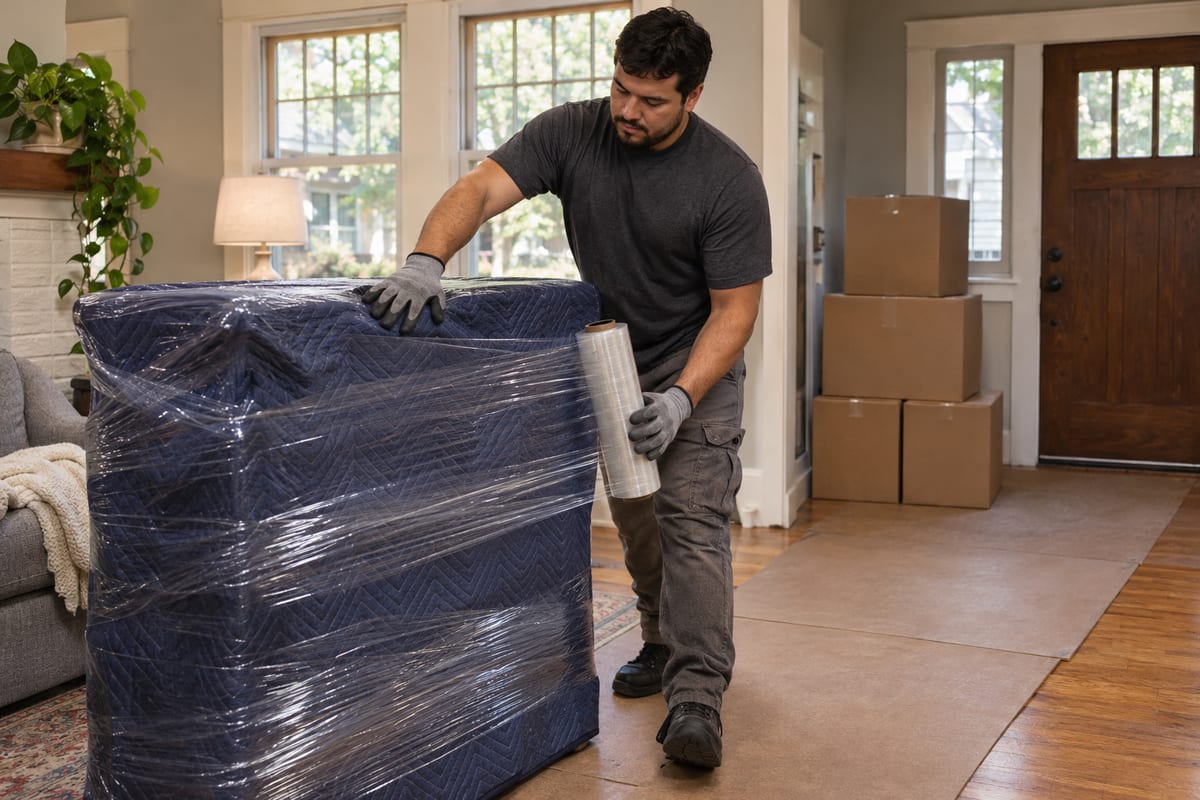
- Moving blankets. One for every piece of wood furniture, plus extras for gaps and corners.
- Stretch wrap. For holding blankets on, and drawers and doors shut. Put a blanket between wrap and wood. Plastic straight against a finish can trap moisture while the container sits in storage.
- Mattress bags. They keep mattresses clean and dry standing against the container wall.
- Boxes and packing tape. A few standard sizes stack better than a pile of mismatched ones.
- A hand truck or appliance dolly. For the fridge, washer and stacks of heavy boxes.
Go Mini's sells straps, moving blankets and boxes. Ask your container company what it offers when you book.
When to hire a crew to load it
Loading a container yourself works when you have a few strong friends, a free weekend and nothing too heavy. It's worth bringing in a crew when:
- Something is too heavy to risk. A piano, a gun safe, a solid-wood armoire or a chest freezer. If there's a piano going in, read what moving a piano involves first.
- There are stairs in the way. A basement, a second floor or a split-level with half-flights between every room.
- You're on the container company's clock. If the pickup date is fixed, the container has to be loaded by then, whatever else is going on that week.
- You want it done once. An experienced moving crew packs tiers tight, without the gaps that let a load shift.
- You need help at both ends. The same crew can unload it at the new house and put everything in the right room.
Minnē Movers sends crews from Minneapolis, Burnsville and Blaine to load and unload containers across the Twin Cities metro. Still choosing a container company? Read our comparison of PODS, Big Blue Boxes and Go Mini's.
Frequently asked questions
How full should a moving pod be?
A moving pod should be packed full and tight, floor to ceiling, with no empty space for things to slide into, while staying under the container's weight limit. If you have extra room, don't leave it as one empty section by the doors. Strap off the last tier firmly and fill gaps with soft items like bedding and cushions.
Do you need to tie things down in a moving pod?
Yes. Strap off each tier to the container's tie-down points as you load. Container companies warn that items can shift during loading and transport if they aren't secured. PODS says customers supply their own straps, and its containers have eyelets or e-track for tie-downs. Go Mini's containers have rails at two heights along the walls.
What should you load first in a moving pod?
Load the heaviest and largest items first: the refrigerator, washer and dryer, dressers and sofa go against the back wall on the floor, with the weight balanced side to side. Tall flat items like mattresses and headboards go along the side walls next, then boxes, heaviest on the bottom.
How long does it take to load a moving pod?
Loading time depends on how much you're moving and how ready it is when loading starts. Having every box packed, sealed and staged by the door, and furniture already taken apart, saves the most time. An experienced moving crew is usually faster than a group of friends doing it for the first time.
Get help on load day
Tell us your container company, your drop-off date and the size of your home, and we'll quote loading, unloading or both. Call 651-460-9952 in Minneapolis, 651-319-5358 in Burnsville, or 763-525-2900 in Blaine, or start with a free quote.