


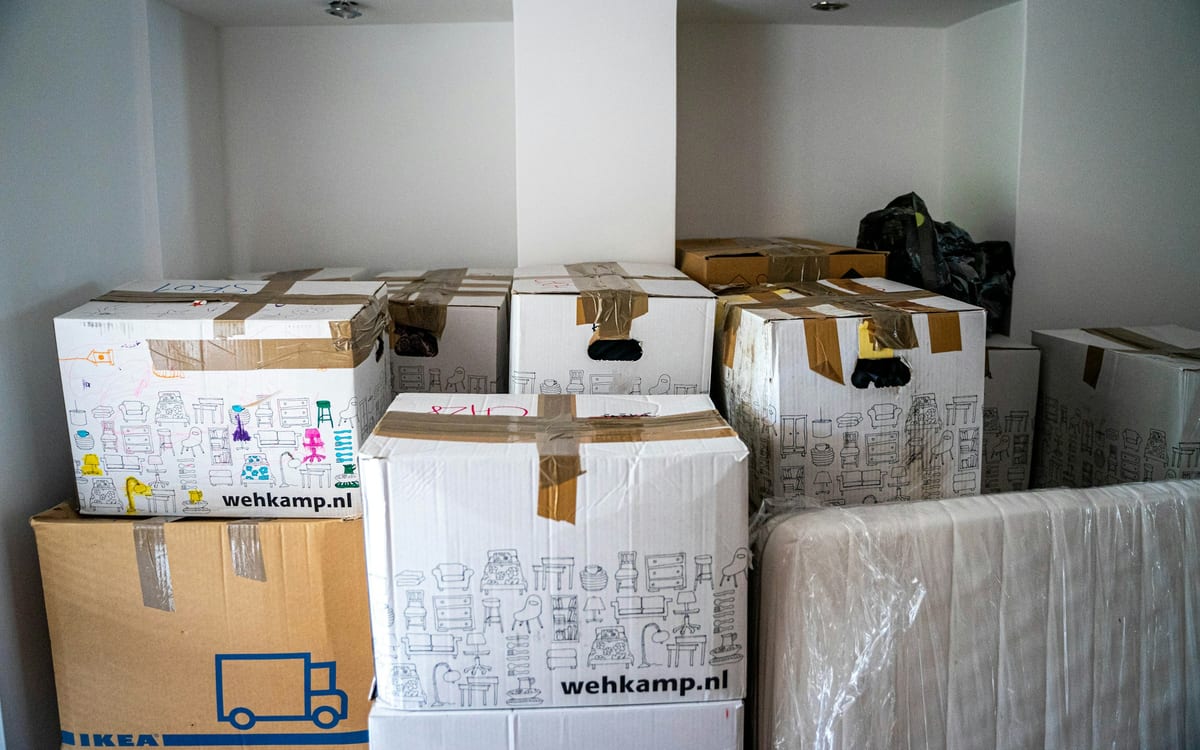
Minnē Movers charges $85 per mover per hour on weekdays and $95 per mover per hour on weekends and holidays for moves in Minneapolis, plus a $150 truck fee within 30 miles of the warehouse and a $1-per-mile fuel surcharge. A typical one-bedroom apartment move runs $700 to $900.
What do movers cost per hour in Minneapolis?
Every charge on a Minnē Movers invoice comes off this list.
| Line item | Weekday | Weekend or holiday |
|---|---|---|
| Labor, per mover per hour | $85 | $95 |
| 2-mover crew, per hour | $170 | $190 |
| 3-mover crew, per hour | $255 | $285 |
| 4-mover crew, per hour | $340 | $380 |
| Truck fee, within 30 miles of the warehouse | $150 | $150 |
| Fuel surcharge, round-trip mileage | $1 per mile | $1 per mile |
| Floor protection, per location | $50 | $50 |
| Wardrobe box rental, each | about $5 | about $5 |
| Senior and military discount | 10% off | 10% off |
Time is rounded to the nearest 15-minute increment and the clock stops when the last item is placed, not when the truck pulls away. Bed reassembly and furniture placement are inside the hourly rate.
The U.S. Bureau of Labor Statistics put the mean hourly wage across all occupations in the Minneapolis-St. Paul-Bloomington metro at $34.73 in May 2024, against $32.66 nationally. A crew is labor, and labor costs more here.
What does a Minneapolis move actually add up to?
Four common shapes of move, at weekday rates with one truck. Mileage is round trip from our Plymouth Avenue warehouse. The apartment rows carry floor protection at one location, the house rows at both.
| Move | Crew and hours | Labor | Truck | Fuel | Floor protection | Total |
|---|---|---|---|---|---|---|
| Studio apartment, elevator building | 2 movers, 2.5 hrs | $425 | $150 | $20 (20 mi) | $50 | $645 |
| 1-bedroom apartment, second-floor walk-up | 2 movers, 3.5 hrs | $595 | $150 | $24 (24 mi) | $50 | $819 |
| 2-bedroom house | 3 movers, 6 hrs | $1,530 | $150 | $40 (40 mi) | $100 | $1,820 |
| 3-bedroom house | 3 movers, 7 hrs | $1,785 | $150 | $50 (50 mi) | $100 | $2,085 |
Those reconcile with what we publish elsewhere: the one-bedroom lands inside the $700 to $900 quoted in our step-by-step guide to local moves, and the two-bedroom inside $1,700 to $2,000. A three-bedroom is already past $2,000; a five-bedroom usually needs eight hours or more. Stairs, clutter and how packed you are when we arrive move the number.
Mileage is the line people underestimate, because the surcharge runs on round-trip miles from the warehouse, not on the distance between your two front doors. A cross-town move and a run to the east metro price differently for that reason alone, part of the arithmetic in moving to Woodbury. Still choosing a side of the river, Minneapolis vs. St. Paul sets the two cities next to each other.
Why does an hourly rate beat a flat quote?
An hourly rate is auditable: arrival time, departure time and crew size, all checkable. A flat quote is one number with the reasoning removed, priced for the mover's worst case, so the organized customer subsidizes the disorganized one.
Minnesota Statutes section 221.161 requires a household goods mover to maintain a tariff of its rates and charges at its principal place of business and at each terminal, and to make it "available to the public for inspection at all times the household goods mover is open for business." The rates above are ours, published rather than filed and forgotten.
The Minnesota Attorney General's guidance on hiring a mover explains why that matters. State law requires movers to file their hourly rate with the Department of Transportation, and the guidance warns that "Some movers may quote below this rate and then attempt to charge the rate they filed with the State." The same office tells consumers to get several written estimates and notes that telephone estimates may not be reliable.
What makes a Minneapolis move take longer?
Hours are the variable you control. These are what eat them:
- Stairs and walk-ups. A second-floor walk-up in Whittier or Uptown adds roughly half an hour to an hour over the same apartment at ground level. A third floor with a turn at the landing costs more.
- Elevators and certificates of insurance. Downtown and North Loop buildings usually require a reserved freight elevator and a certificate of insurance naming the building. Book that window when you book us; a crew waiting on a building manager is still on the clock.
- Long carries. Narrow Northeast streets and alley-only access behind older duplexes can leave the truck a long walk from your door.
- Things the crew cannot legally load. Propane cylinders, gas cans and half-used paint thinner have to be dealt with on the spot when they surface in the garage, and that is time on the clock. Clear them out first; the full roster is in what movers won't move.
- Unfinished packing. The most expensive thing a customer can do is still be taping boxes when the crew walks in. Our packing calculator tells you how many boxes you need.
What are the parking and permit costs nobody quotes you?
Blocking a lane, a street or a sidewalk in Minneapolis, or hooding a parking meter, takes an obstruction of right-of-way permit from the City, applied for through its Roway system. The City says plainly that "There is no cost for the permit," which is not the same as free: it also lists fees for closing a travel or parking lane, for hooding meters, for lost meter revenue and for traffic control agents. The City requires 48 hours' notice to post No Parking signs and 24 hours to hood meters, so ask Public Works before you book. A residential critical parking permit will not cover you either; the City bars their use for commercial vehicles.
Published Minneapolis Impound Lot rates are $222 for a standard tow plus $18 per day in storage, assessed by midnight, and a $6 notification letter.
How does winter change the math?
A Minneapolis snow emergency puts special parking rules in force for three days: nothing on either side of snow emergency routes from 9 p.m. on Day 1, nothing on the even side of non-route streets or on parkways from 8 a.m. on Day 2, nothing on the odd side from 8 a.m. on Day 3. There is no fixed snowfall trigger; the City weighs earlier snowfall, accumulation, timing, street conditions, forecast and time of year.
The City says its "roughly 80 tow trucks remove an average of 1,100 illegally parked vehicles each snow emergency," about 20% of the cars parked illegally. Moving between November and March, check the night before and move your own car first. Cold-weather logistics are in our Minnesota winter moving tips.
Do federal moving rules cover a Minneapolis move?
Mostly not. FMCSA's household goods rules govern interstate moves, meaning any move that crosses a state line, including one routed through another state. A move that starts and ends inside Minnesota is intrastate and falls to the state. So the federal protections you find first on Google, the 110 percent cap on collecting at delivery against a non-binding estimate under 49 CFR 375.407 and the written estimate and physical survey under 49 CFR 375.401, govern a move from Minneapolis to Denver, not one from Uptown to Longfellow.
What governs a local move is the MnDOT household goods mover permit. MnDOT requires a USDOT number and proof of not less than $100,000/$300,000 public liability and not less than $50,000 destruction of property, and Minnesota Statutes section 221.141 requires cargo insurance or a cargo bond of $50,000, on top of the public tariff above. Ours are on our safe movers page. If your move does cross a state line the federal rules apply in full, and our interstate moving page walks through them.
FMCSA describes basic released value protection as making the mover responsible for no more than 60 cents per pound per article; its own example is a 50-inch television weighing 25 pounds paying out $15. Anything worth more than $100 per pound is an item of extraordinary value, which FMCSA illustrates with jewelry, silverware, china, furs and antiques, and it must be declared in writing.
How do you estimate your own Minneapolis move in five minutes?
- Count bedrooms and pick a crew: studio or one-bedroom, two movers; two or three bedrooms, three movers; four or more, four.
- Take the hours from the table above, plus an hour if there are stairs at both ends.
- Multiply crew size by $85 for a weekday or $95 for a weekend, then by hours.
- Add $150 for the truck if you are inside 30 miles of the warehouse.
- Add $1 for every round-trip mile from the warehouse.
- Add $50 per location for floor protection, plus about $5 per wardrobe box.
- Take 10% off if you qualify for the senior or military discount.
The instant quote tool runs the same math, and a free estimate gets you a written number. Our pricing structure sheet is these same figures in downloadable form. None of it covers the paperwork that follows the truck: address changes with DVS, USPS and your utilities cost nothing but carry deadlines, and they are laid out in changing your address in Minnesota.
Frequently asked questions
Is $100 a good tip for movers?
It is on the generous side of normal. Tipping is never required and is not built into our rates. For good service, $20 to $40 per mover is typical, so $100 split across a three-mover crew is about $33 each, in the upper half of that band.
How much should I pay for three hours of movers in Minneapolis?
A two-mover crew at the weekday rate is $170 an hour, so three hours of labor is $510. Add the $150 truck fee and a fuel surcharge of $1 per round-trip mile, about $20 on a typical in-city move, and you are near $680 before options like floor protection at $50 per location. The same three hours on a Saturday is $570 of labor.
What is the cheapest day to hire movers in Minneapolis?
A weekday. Minnē Movers charges $85 per mover per hour Monday through Friday against $95 on weekends and holidays, so a three-mover crew working six hours costs $1,530 on a Tuesday and $1,710 on a Saturday. That is $180 for identical work. Availability matters as much as price, which we cover in best day to move house in Minnesota.
What items will movers not move?
Hazardous materials. FMCSA's non-allowables list includes paints and paint thinners, gasoline, lighter fluid, nail polish remover, fireworks, propane cylinders, oxygen bottles, automotive repair chemicals and radio-pharmaceuticals. There is a narrow exception for small quantities of medicinal and toilet articles, up to 70 ounces total. Packing any of it into a box without telling your mover also limits the mover's liability for the shipment.
Do Minneapolis movers charge for travel time and mileage?
Minnē Movers does, and states it up front rather than burying it. It is a $150 truck fee for any move within a 30-mile radius of our warehouse, plus a fuel surcharge of $1 per mile on round-trip mileage from that warehouse. There is no extra hourly charge for driving between your addresses beyond the crew hours already on the clock.
Does Minnesota charge sales tax on moving services?
No. The Minnesota Department of Revenue's guidance for transportation service providers states that common carriers are hired to transport goods and that fees charged to provide these services are not taxable. Packing materials are different: boxes, tape and paper sold to you are taxable retail sales, so expect sales tax on supplies only.
We have run more than 8,000 moves in the Twin Cities, with over 1,500 five-star Google reviews across the company and more than 1,300 in Minneapolis alone. The rates above are the ones our dispatchers quote on the phone. Minnē Movers is licensed as USDOT #3334469 and MN DOT #384959. Call Minneapolis and the West Metro at 651-460-9952, Burnsville at 651-319-5358 or Blaine at 763-525-2900. Reviews are collected at minnemoversreviews.com.